
Riyadh, Saudi Arabia – August 10, 2026 – Why the AI era will be won by companies that re-architect, not simply adopt
For the past two years, enterprise conversations about AI have focused heavily on adoption. How quickly can we deploy it? How many employees are using it? How many pilots have we launched? Those questions made sense when access was limited and experimentation was new. They are less useful now.
McKinsey’s 2025 research found that 88% of organizations use AI in at least one business function. Yet only around one-third have begun scaling it across the enterprise, and just 39% report measurable EBIT impact. The issue is not that organizations have failed to adopt AI. Many have adopted it enthusiastically. The issue is that adoption and value are not the same thing.
Technology is advancing rapidly, but the businesses around it are changing much more slowly. That gap explains why promising pilots often produce modest results. The main constraint is no longer access to intelligence. It is whether the enterprise is prepared to reorganize around it.
The One-Motor Trap
We have seen this pattern before. When commercial electric power arrived in the late nineteenth century, many factories replaced their central steam engine with a central electric motor. But they retained the same belts, shafts, workflows and floor plans. They had adopted the new power source, but the factory was still designed for the old one.
The major productivity gains came later, when manufacturers stopped asking how electricity could power the factory they already had and started asking what a factory designed around electricity should look like. They placed motors on individual machines, changed layouts and enabled entirely new methods of production. The breakthrough was not a better motor. It was a different floor.
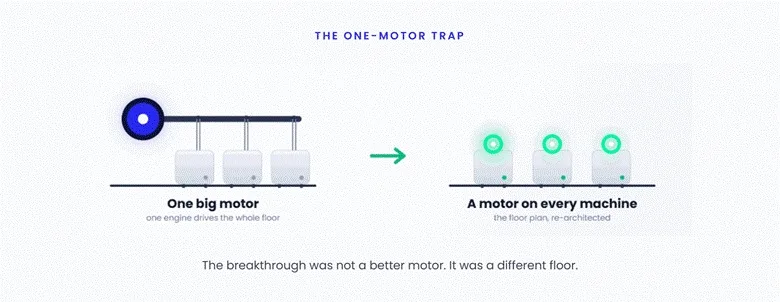
Many companies are now repeating the same mistake with AI. They replace a person with a copilot, add a chatbot to an existing service process or place an AI assistant beside an old workflow, then call the result transformation. It is the digital equivalent of dropping one large motor where the steam engine used to stand.
I once watched a company roll out AI copilots across its workforce. The launch was substantial, licenses were available to everyone and adoption dashboards quickly turned green. Six months later, the work had barely changed. Employees were writing the same emails, preparing the same reports and moving information through the same approval chains, only slightly faster.
The company had invested heavily to save minutes inside processes it had never stopped to question. That is the One-Motor Trap: the same floor with a faster belt. The AI era will not be won by the companies that adopt fastest. It will be won by those willing to re-architect.
Re-Architecture Starts with Data
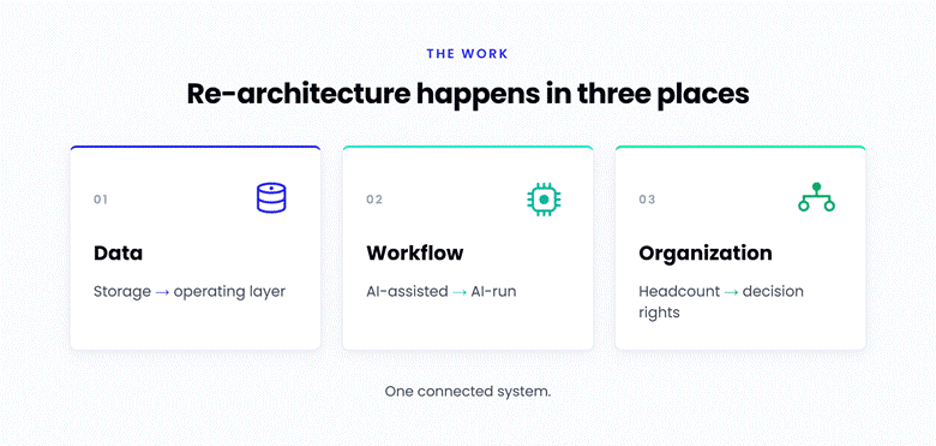
Re-architecture needs to happen in three connected places: data, workflows and the organization itself. The first shift is from treating data as storage to treating it as an operating layer.
Most organizations have plenty of data, but much of it remains fragmented, delayed, difficult to access or trapped in systems designed primarily for reporting. That may support a dashboard at the end of the month. It does not support intelligence operating inside the business in real time.
AI needs data that is connected, governed, permissioned and available at the point of action. A useful test is simple: can your AI reach live operational data without triggering a six-week integration project? When the answer is no, the bottleneck is usually not the model. It is the foundation underneath it.
Consider industrial safety. An AI system can help anticipate risk only when inspection records, incident histories, workforce information and operating conditions are connected and current. When those inputs remain scattered across paper records and isolated systems, adding an assistant on top produces a polished interface over an incomplete picture. The real work begins by creating a live, trusted operating layer. The AI comes after that.
Redesign the Workflow, Not Just the Task
The second shift is from AI-assisted work to workflows designed around AI execution, with human judgment placed deliberately where it adds the most value. Most early AI use cases focus on individual tasks: drafting an email, summarizing a meeting, preparing a status update or searching a document.
These tools can be useful, but task-level efficiency is not the same as transformation. Sometimes we are simply automating the wrong work.
An AI can write a weekly status update beautifully. But perhaps that update is then copied into a management summary, fed into another summary and ultimately ignored. In that case, we have automated the production of a document that can now be ignored faster. Bureaucracy, finally enjoying modern infrastructure.
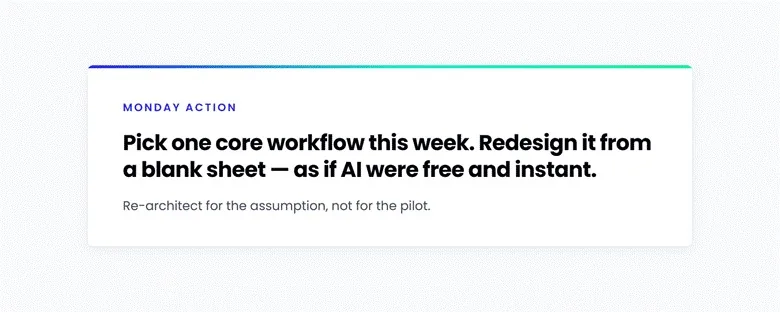
The better approach is to begin with a blank sheet. Choose one important process and redesign it under the assumption that intelligence is available instantly and at very low marginal cost. Decide what AI can execute, where a person must exercise judgment, which exceptions require escalation and what controls are necessary. Then build toward that design instead of attaching AI to every existing step.
When a human must still move every stage forward, the workflow has been assisted rather than re-architected. McKinsey’s research supports this distinction. Among the organizational factors it examined, workflow redesign had the strongest effect on an organization’s ability to generate measurable financial value from generative AI. The value comes from changing how work is performed, not simply helping people move through the old process faster.
Redesign Decision Rights
The third shift is organizational. For more than a century, companies have largely been designed around headcount, functions and reporting lines. As AI systems and agents take on more execution, another constraint becomes increasingly important: who is allowed to decide what, under which conditions and how quickly?
This is where technology-led initiatives often collide with the operating model. A company may build an AI system that detects an operational issue and recommends the right response in seconds. But if every action above a certain threshold still requires a director’s approval, the recommendation may sit in an inbox for two days.
The company has bought real-time intelligence and wrapped it in a business-hours organization. The machine is ready in seconds. The company is ready by Thursday.
The bottleneck has moved from “Can we determine what to do?” to “Are we allowed to do it yet?” Solving that problem requires leaders to revisit decision thresholds, accountability, escalation paths and the boundary between automated action and human control.
These are not technology settings buried in a backlog. They are operating-model decisions. This is why re-architecture is an organizational question before it is a technology question. A business can have the best AI in its industry and still move at the speed of its slowest approval.
Redraw the Building
BCG’s 2025 research found that only 5% of companies had become what it calls “future-built” organizations generating AI value at scale, while 60% were seeing little or no material value despite substantial investment. Those future-built companies achieved five times the revenue gains and three times the cost reductions from AI compared with others.
Their advantage was not access to a secret model. It was their ability to integrate AI into core decisions, workflows and operations. This is the difference between AI readiness and enterprise readiness.
AI readiness asks whether the technology, infrastructure and use cases exist. Enterprise readiness asks whether data can move, workflows can change and decision rights can keep pace.
The practical starting point is not another portfolio of pilots. Choose one important workflow and redesign it from a blank sheet as though AI were free and instant. Then add the necessary human judgment, controls and governance.
The gap between that design and the way the work happens today is not merely an implementation gap. It is the strategy.
The question is no longer whether your organization has adopted AI. It is whether you have redrawn the building around it.
AI is not the hard part. Reinventing the enterprise is.
Giedre Malinauskaite
Chief Strategy Officer (CSO)
Riyadh, Saudi Arabia – July 12, 2026 – For a while, saying “we are adopting AI” sounded like a strategy.
It is not.
It is a starting point. Sometimes it is just a sentence in a presentation.
The real question for enterprises today is not whether they are using AI. Most already are. The real question is whether AI is improving anything that matters: revenue, productivity, customer experience, speed, risk, resilience, or decision-making.
That is where the conversation becomes more serious.
AI adoption is becoming common. AI advantage is still rare.
The gap between use and value
The market has moved quickly. AI is now embedded in functions across the enterprise, from marketing and sales to IT, operations, finance, customer service, and knowledge management.
McKinsey’s 2025 State of AI survey found that 88% of respondents say their organizations regularly use AI in at least one business function. But only about one-third say their companies have begun to scale AI programs. (McKinsey & Company)
That gap matters.
It tells us that access to AI is no longer the main differentiator. The differentiator is execution.
Many organizations are experimenting. Fewer are scaling. Even fewer are capturing enterprise-level financial impact. McKinsey reported that only 39% of respondents saw EBIT impact at the enterprise level from AI. (McKinsey & Company)
This is the point every leadership team needs to face clearly: using AI and creating value from AI are not the same thing.
One creates activity.
The other creates advantage.
Context is what makes AI commercially useful
From a commercial perspective, AI becomes valuable when it is applied to the right problem, inside the right workflow, with the right data, and with a clear definition of success.
That is context.
Without context, AI can generate outputs. With context, AI can support outcomes.
A sales team does not need a generic AI tool that writes slightly better emails. It needs intelligence that understands account priorities, buying signals, customer history, sector dynamics, deal progression, and the next best action.
A service team does not need a chatbot that answers in polished language but fails to resolve the issue. It needs AI connected to service history, product data, policies, escalation paths, and customer expectations.
An operations team does not need dashboards that look impressive but do not change decisions. It needs AI that helps people identify risk, prioritize action, and improve performance.
This is why context matters commercially. It connects AI to value.
The companies that win with AI will not be the ones running the most pilots. They will be the ones that choose fewer, sharper priorities and execute them deeply.
AI should start with the business problem, not the tool
A common mistake is to begin with the technology.
A new model is launched. A new agent is announced. A new feature becomes available. Suddenly, teams start looking for a place to use it.
That sequence is backwards.
The better question is: what business outcome are we trying to improve?
Do we need to increase conversion?
Reduce churn?
Shorten cycle time?
Improve service quality?
Lower operational risk?
Increase asset uptime?
Improve forecasting?
Enable faster decision-making?
Once the business outcome is clear, AI can be designed around it. The data requirements become clearer. The workflow implications become clearer. The ownership model becomes clearer. The KPI becomes clearer.
This is not as exciting as saying “agentic AI” six times in a meeting, but it is far more useful. Humanity survives another buzzword, barely.
Workflow redesign is where value appears
One of the strongest signals from the current AI market is that value comes when organizations redesign how work gets done.
McKinsey found that AI high performers are nearly three times more likely than others to say their organizations have fundamentally redesigned individual workflows. The same research notes that workflow redesign is one of the strongest contributors to meaningful business impact. (McKinsey & Company)
This is a critical lesson.
AI cannot simply be placed on top of old processes and expected to deliver transformation. If the workflow remains slow, fragmented, manual, and unclear, AI may only help people move through a bad process faster.
That is not transformation. That is automation with better lighting.
Real AI value often requires rethinking the process itself. Where should AI support a decision? Where should a human remain accountable? What data should be available at the point of action? What approval steps can be simplified? What risks require validation? What should be measured before and after implementation?
This is where AI becomes operational, not theoretical.
Leadership ownership matters
Another important finding from McKinsey is that high-performing organizations are much more likely to have senior leaders actively owning and driving AI adoption. (McKinsey & Company)
That makes sense.
AI value does not appear because a technology team launched a pilot. It appears when business leaders, technology teams, data teams, and frontline users work around the same outcome.
The CRO, CIO, COO, CFO, and business unit leaders all have a role to play. AI is not only a technology agenda. It is a business agenda.
Commercial leaders especially need to be involved early. They understand where value is created and where friction exists. They know which customer problems are worth solving. They know which parts of the sales or service journey are slow, inconsistent, or expensive. They know where better intelligence can change behavior.
If AI is disconnected from commercial priorities, it becomes another tool.
If it is connected to growth, productivity, and customer impact, it becomes a strategic capability.
The role of trusted partners
As AI becomes more important, organizations also need to be honest about what they can build alone.
Some companies have mature data environments, advanced engineering teams, and strong AI governance. Many do not. Even those that do still need help connecting strategy, technology, industry context, and implementation.
This is where the partner model matters.
The right partner should not simply bring technology. Technology is necessary, but not enough. The right partner should help define the use case, assess the data foundation, design the architecture, connect the workflow, manage governance, support adoption, and measure the outcome.
In other words, the partner should help turn AI from a concept into a working capability.
For a market like Saudi Arabia, this becomes even more important. Organizations are moving quickly, but they also need trusted foundations: secure cloud environments, local understanding, regulatory awareness, data governance, and solutions built around the realities of the Kingdom’s industries.
AI needs global capability, but it also needs local context.
From adoption to advantage
The next phase of AI will separate organizations into two groups.
The first group will continue to adopt AI broadly, experiment often, and struggle to explain the value.
The second group will be more disciplined. They will identify the business outcomes that matter. They will connect AI to trusted data. They will redesign workflows. They will assign ownership. They will measure impact. They will build capability over time.
The second group will create the advantage.
For executives, the message is clear: do not confuse AI activity with AI progress.
A pilot is not progress unless it teaches something useful.
A tool is not progress unless it improves the work.
A model is not progress unless it supports a better decision.
A dashboard is not progress unless it changes what someone does next.
AI advantage is created when intelligence is placed in the right context and connected to the right outcome.
That is the real opportunity for enterprises now.
Not adoption for its own sake.
Not experimentation without direction.
Not another layer of technology noise.
The opportunity is to build AI that understands the business, improves the work, and creates measurable value.
That is where adoption ends.
And advantage begins.
Raafat H. Sindi
Chief Revenue Officer (CRO)
Riyadh, Saudi Arabia – June 29, 2026 – AI has entered the enterprise faster than almost any technology cycle before it.
In boardrooms, ministries, industrial sites, hospitals, banks, and customer operations, the question is no longer whether AI matters. That debate is over. The real question is whether AI can move beyond impressive demonstrations and start changing how organizations actually operate.
That is where many enterprises are now facing a harder truth.
The world has no shortage of AI tools. What it lacks is AI that understands the reality of the enterprise using it.
A model can summarize a document. It can generate a report. It can analyze patterns. It can even help automate decisions. But without the right business context, operational data, governance, workflows, and domain understanding around it, AI remains generic. Useful, perhaps. Interesting, certainly. Transformational, not yet.
This is the shift that matters now: from generic AI to domain intelligence.
Adoption is not the same as transformation
The pace of AI adoption is remarkable. Stanford’s 2025 AI Index reported that 78% of organizations were using AI in 2024, up from 55% the year before. It also showed record levels of private investment, including $33.9 billion globally in generative AI private investment in 2024. (Stanford HAI)
But adoption alone does not prove value.
McKinsey’s 2025 State of AI survey found that while nearly nine out of ten respondents say their organizations regularly use AI, only about one-third say their companies have begun to scale AI programs. Just 39% report enterprise-level EBIT impact. (McKinsey & Company)
That gap tells us something important. The issue is not access to AI. Access is becoming easier every month. The real challenge is making AI work inside complex organizations where data is fragmented, processes are deeply embedded, decisions carry risk, and outcomes must be measurable.
Enterprises do not need more isolated experiments. They need AI that is connected to the way their business actually works.
Why context matters
Context is what turns data into intelligence.
In an enterprise, context includes the history of operations, the meaning behind data, the constraints of the industry, the regulatory environment, the decision-making process, and the specific outcomes the organization is trying to improve.
A safety recommendation in an industrial facility cannot be treated like a generic text response. It must understand the site, the asset, the procedure, the permit, the risk, the crew, and the consequences of a wrong answer.
A customer insight in banking cannot be separated from compliance, privacy, service history, product eligibility, and customer trust.
A supply chain recommendation cannot ignore local market realities, procurement cycles, demand volatility, or operational dependencies.
This is why enterprise AI cannot be built as a layer floating above the business. It must be grounded inside the business.
The most valuable AI will not simply answer questions. It will understand why the question matters, what data should be trusted, what decision is being supported, who is accountable, and what outcome is expected.
That is the difference between automation and intelligence.
Domain intelligence is the next competitive advantage
For the last decade, digital transformation was often defined by moving systems to the cloud, modernizing infrastructure, and collecting more data. These foundations remain essential. But AI is now forcing a more advanced question: can organizations convert those foundations into decisions, actions, and measurable improvements?
This is where domain intelligence becomes critical.
Domain intelligence is AI applied with a deep understanding of a specific industry, process, environment, and objective. It is not AI in general. It is AI for energy operations, industrial safety, logistics, healthcare workflows, customer service, public services, and enterprise productivity.
It understands the language of the domain. It respects the constraints of the domain. It is designed around the outcomes that matter in that domain.
This is also why proprietary data is becoming so important. IBM’s 2025 CEO Study found that 72% of CEOs say proprietary data is key to unlocking the value of generative AI, while 50% say their organizations have disconnected technology because of the pace of recent investments. (IBM)
That is the contradiction many leaders are now managing. They know their own data is the key to differentiation, but their technology environments are often too fragmented to use it effectively.
AI does not fix that problem by magic. It exposes it.
Saudi Arabia’s opportunity
For Saudi Arabia, this shift is especially important.
The Kingdom is not approaching AI as a side initiative. It is building AI into the national transformation agenda. The National Strategy for Data and AI includes 66 goals and targets by 2030, including ranking among the top 15 countries in AI, developing 20,000 data and AI specialists, attracting SAR 75 billion in investment, and training 40% of the workforce in basic data and AI skills. (Saudipedia)
This creates a different level of responsibility for technology companies operating in the Kingdom.
The opportunity is not only to deploy global technologies locally. It is to build local capability, local solutions, and local intelligence that can address the realities of Saudi industries and institutions.
That matters in sectors such as energy, industry, mobility, government, and healthcare, which are all priority areas within the national data and AI agenda. (Saudipedia) These sectors do not need AI as a generic productivity layer. They need AI that can support complex, high-impact environments.
They need context.
The future belongs to organizations that connect the layers
The next phase of AI will reward organizations that can connect four layers.
First, the cloud foundation: scalable, secure, and resilient infrastructure.
Second, the data foundation: connected, governed, and usable data.
Third, the AI layer: models, agents, automation, analytics, and decision support.
Fourth, and most importantly, the context layer: the workflows, domain knowledge, governance, and business outcomes that make AI relevant.
Without the first three layers, AI cannot scale. Without the fourth, it cannot create meaningful value.
This is where many AI programs succeed or fail. Not in the demo. Not in the model selection. Not in the announcement. They succeed or fail when AI enters the real flow of work.
Does it help people make better decisions?
Does it reduce operational risk?
Does it improve productivity?
Does it strengthen resilience?
Does it create value that leaders can measure?
If the answer is unclear, the AI program is not yet mature.
From promise to impact
We are entering a more serious phase of AI.
The early excitement was necessary. It helped organizations imagine what is possible. But the next stage requires discipline. It requires foundations. It requires governance. It requires industry knowledge. It requires the ability to move from pilots to production.
Most of all, it requires context.
Generic AI will continue to improve. Models will become faster, cheaper, and more capable. But enterprise advantage will not come from using the same models everyone else can access. It will come from combining those capabilities with proprietary data, domain expertise, trusted infrastructure, and a deep understanding of how each organization creates value.
That is where AI becomes more than a tool.
It becomes intelligence that belongs to the enterprise.
And for Saudi Arabia, it becomes part of something larger: building national capability, advancing digital leadership, and turning ambition into real operational progress.
The future of AI is not generic.
The future is domain-specific, enterprise-ready, and built in context.
Ends.
Abdullah Jarwan
Chief Executive Officer at CNTXT
Riyadh, Saudi Arabia – August 5, 2025 – In today’s rapidly evolving industrial landscape, the twin pillars of safety and efficiency are no longer negotiable; they are paramount. As industries across Saudi Arabia and the wider MENA region accelerate their digital transformation journeys in alignment with Vision 2030, the need for advanced, intelligent safety solutions has never been more critical. Enter InSafe—an end-to-end industrial safety platform developed by CNTXT, purpose-built to minimize operational risk and drive safety excellence through the power of cloud intelligence and AI.
InSafe’s mission is audacious yet essential: to achieve zero workplace incidents by transforming how industrial safety is managed. It is an all-in-one solution meticulously designed to streamline safety processes, automate hazard monitoring, simplify work permits, and provide real-time insights, ensuring all operations are conducted safely and efficiently. For forward-looking industrial leaders, InSafe isn’t just software—it’s a strategic asset to protect people, ensure operational integrity, and embed safety into the fabric of day-to-day operations.
Unlocking Comprehensive Safety Through Core Workflows:
InSafe’s power lies in its seamless integration across the entire safety management lifecycle, focusing on six critical workflows:
- Safety Command Centre: InSafe’s power lies in its seamless integration across the entire safety management lifecycle, focusing on six critical workflows: Safety Command Centre: This central hub provides you with a single, clear view of your entire operational environment. It allows you to create zones, track permits and personnel in real-time, and coordinate emergency responses with unparalleled efficiency, ensuring you have total command and control during any situation.
- Work Planning: InSafe revolutionizes work planning by centralizing task management, hazard identification, isolation processes, and permit handling. This intelligent integration, complete with clear timelines, leads to streamlined operations, smarter planning, and real-time collaboration among teams.
- Job Safety Assessment (JSA): Leveraging domain-driven AI, InSafe takes JSA to a new level. It intelligently identifies localized hazards and proactively recommends control measures, providing real-time mitigation strategies. This empowers organizations to enhance compliance and reliability in their safety assessments.
- Isolation Planning: For critical tasks requiring system de-energization, InSafe ensures precision and integrity. It generates precise isolation plans based on industry best practices and local conditions, and crucially, verifies their integrity post-implementation. This feature simplifies complex lockout/tagout workflows, defines clear safety zones, and prevents unauthorized access, enhancing safety and compliance.
- Permit-to-Work (PTW): InSafe ushers in a new era of permit management with its 100% digital platform. It offers customizable templates that perfectly match specific business processes, providing real-time status updates for every permit. This ensures full compliance with auditing requirements, making paper-based systems obsolete.
- KPIs & Auditing: Staying ahead of compliance is effortless with InSafe’s auditing capabilities. It ensures real-time monitoring of safety protocols, driven by AI-powered audit insights. This leads to simplified compliance processes and automated reporting, providing clear, concise data on safety performance.
Intelligence at Its Core: The Power of Localized AI and Data:
What sets InSafe apart is its foundation in cloud intelligence and localized AI, specifically developed in Saudi Arabia by CNTXT. It transforms raw data into actionable insights by integrating diverse data sources:
- Historical Work Permits: Learning from past experiences to predict future risks.
- General Instructions & Domain-Specific Documents: Providing context-rich guidance.
- Assets Data Records: Connecting safety to the physical operational environment.
This interconnected data ecosystem powers the InSafe Co-pilot—an intelligent assistant that delivers measurable outcomes: precise Isolation Plans based on best practices, intelligent Hazard Identification & Control leveraging domain knowledge, and real-time Risk Classification based on EHS factors.
Tailored, Scalable, and Secure for the Future:
InSafe is purpose-built to meet the evolving demands of industrial operations, combining hyper-scale capabilities with unmatched flexibility and security. Developed in Saudi Arabia by CNTXT, InSafe ensures full compliance with national data privacy and cybersecurity standards—delivering resilience, reliability, and trust at scale.
The platform is designed for complete customization, allowing businesses to set up work permit templates, define workflows, create access areas based on risk classifications (with geofencing), and configure performance metrics for tailored reporting. Comprehensive user management, location management, form management, and contractor management features allow organizations to maintain total control over roles, permissions, trainings, and operational hierarchy.
Furthermore, InSafe offers seamless integration with existing systems, automating user and access management to save time and reduce manual tasks. For organizations preferring a bespoke approach, it offers intuitive tools to manually add users, assign roles, create sites, and customize access levels within one intuitive platform.
InSafe, powered by CNTXT, is more than just a safety solution; it’s a strategic imperative for industries committed to smarter operations and a safer future. By leveraging cloud intelligence and AI, InSafe enables businesses to prioritize safety without sacrificing efficiency, truly transforming industrial safety in the Kingdom and beyond.
Saudi Arabia – April 20, 2025 – CNTXT, as the exclusive reseller of Google Cloud Platform Services for local organizations purchasing through an entity in Saudi Arabia, today announced the signing of an agreement with Aramco, one of the world’s leading integrated energy and chemicals companies. This agreement can help Aramco to leverage the full range of Google Cloud offerings, including a diverse portfolio of solutions and services available on the Google Cloud Marketplace.
This collaboration comes on the heels of Google Cloud’s official launch of its Saudi Arabia cloud region on November 15, 2023. The new cloud region underscores Google Cloud’s commitment to supporting the Kingdom’s digital transformation journey, aligning with Vision 2030’s goals to establish Saudi Arabia as a global technology hub.
Under the agreement, Aramco can utilize Google Cloud’s advanced technology to promote operational efficiency, innovation, and sustainability initiatives across its operations. The adoption of advanced cloud solutions can support Aramco in achieving its ambitions of enhancing digital capabilities and fostering innovation in the energy sector.
CNTXT continues to play a pivotal role in facilitating access to Google Cloud services for local organizations purchasing through an entity in the Kingdom. By ensuring compliance with Saudi regulations and offering localized expertise, CNTXT continues to strengthen the adoption of world-class cloud technology across the region.
“This agreement marks a significant milestone in Saudi Arabia’s digital transformation journey,” said Abdullah Jarwan, CEO of CNTXT. “Through this collaboration, Aramco can harness the power of Google Cloud’s advanced solutions to unlock new opportunities and help drive innovation. CNTXT remains committed to empowering organizations with the technology they need to succeed in today’s dynamic digital landscape.”
Sami Al-Ajmi, Aramco Digital and Information Technology Senior Vice President (A), commented: “Aramco is proud to partner with CNTXT and Google Cloud to help accelerate our digital transformation efforts. By adopting Google Cloud’s innovative technologies, we aim to enhance operational efficiency, promote sustainability initiatives, and foster a culture of innovation across our organization. This collaboration aligns with our vision of leveraging advanced digital solutions to shape the future of energy.”
Abdul Rahman Al Thehaiban, Managing Director, Middle East, North Africa & Turkey, Google Cloud, added: “We are thrilled to see this partnership come to life, helping one of the world’s leading integrated energy and chemicals companies to adopt Google Cloud’s industry-leading solutions. Together with CNTXT, we look forward to supporting Aramco and other organizations to realize their digital transformation goals.”
Through this collaboration, CNTXT, Aramco and Google Cloud can help drive innovation, accelerate digital transformation, and contribute to Saudi Arabia’s position as a global leader in technology and sustainability.