

Riyadh, Saudi Arabia – August 10, 2026 – Why the AI era will be won by companies that re-architect, not simply adopt
For the past two years, enterprise conversations about AI have focused heavily on adoption. How quickly can we deploy it? How many employees are using it? How many pilots have we launched? Those questions made sense when access was limited and experimentation was new. They are less useful now.
McKinsey’s 2025 research found that 88% of organizations use AI in at least one business function. Yet only around one-third have begun scaling it across the enterprise, and just 39% report measurable EBIT impact. The issue is not that organizations have failed to adopt AI. Many have adopted it enthusiastically. The issue is that adoption and value are not the same thing.
Technology is advancing rapidly, but the businesses around it are changing much more slowly. That gap explains why promising pilots often produce modest results. The main constraint is no longer access to intelligence. It is whether the enterprise is prepared to reorganize around it.
The One-Motor Trap
We have seen this pattern before. When commercial electric power arrived in the late nineteenth century, many factories replaced their central steam engine with a central electric motor. But they retained the same belts, shafts, workflows and floor plans. They had adopted the new power source, but the factory was still designed for the old one.
The major productivity gains came later, when manufacturers stopped asking how electricity could power the factory they already had and started asking what a factory designed around electricity should look like. They placed motors on individual machines, changed layouts and enabled entirely new methods of production. The breakthrough was not a better motor. It was a different floor.
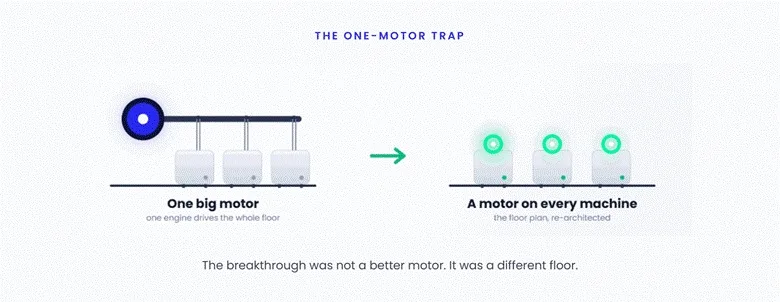
Many companies are now repeating the same mistake with AI. They replace a person with a copilot, add a chatbot to an existing service process or place an AI assistant beside an old workflow, then call the result transformation. It is the digital equivalent of dropping one large motor where the steam engine used to stand.
I once watched a company roll out AI copilots across its workforce. The launch was substantial, licenses were available to everyone and adoption dashboards quickly turned green. Six months later, the work had barely changed. Employees were writing the same emails, preparing the same reports and moving information through the same approval chains, only slightly faster.
The company had invested heavily to save minutes inside processes it had never stopped to question. That is the One-Motor Trap: the same floor with a faster belt. The AI era will not be won by the companies that adopt fastest. It will be won by those willing to re-architect.
Re-Architecture Starts with Data
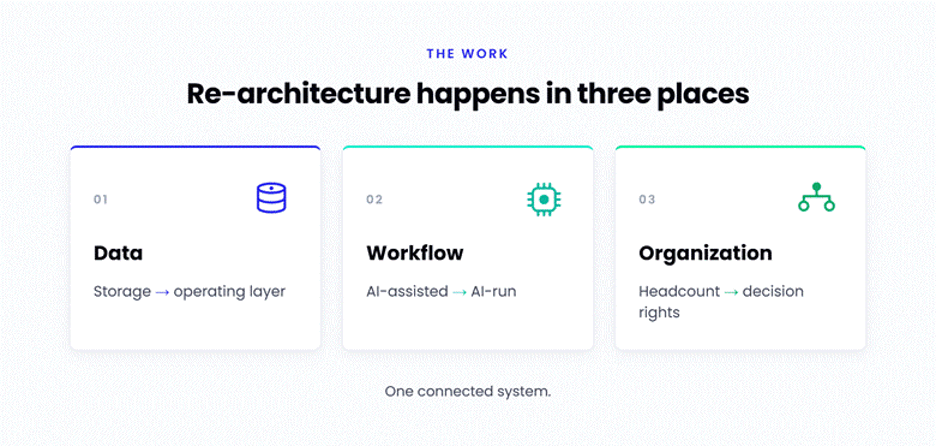
Re-architecture needs to happen in three connected places: data, workflows and the organization itself. The first shift is from treating data as storage to treating it as an operating layer.
Most organizations have plenty of data, but much of it remains fragmented, delayed, difficult to access or trapped in systems designed primarily for reporting. That may support a dashboard at the end of the month. It does not support intelligence operating inside the business in real time.
AI needs data that is connected, governed, permissioned and available at the point of action. A useful test is simple: can your AI reach live operational data without triggering a six-week integration project? When the answer is no, the bottleneck is usually not the model. It is the foundation underneath it.
Consider industrial safety. An AI system can help anticipate risk only when inspection records, incident histories, workforce information and operating conditions are connected and current. When those inputs remain scattered across paper records and isolated systems, adding an assistant on top produces a polished interface over an incomplete picture. The real work begins by creating a live, trusted operating layer. The AI comes after that.
Redesign the Workflow, Not Just the Task
The second shift is from AI-assisted work to workflows designed around AI execution, with human judgment placed deliberately where it adds the most value. Most early AI use cases focus on individual tasks: drafting an email, summarizing a meeting, preparing a status update or searching a document.
These tools can be useful, but task-level efficiency is not the same as transformation. Sometimes we are simply automating the wrong work.
An AI can write a weekly status update beautifully. But perhaps that update is then copied into a management summary, fed into another summary and ultimately ignored. In that case, we have automated the production of a document that can now be ignored faster. Bureaucracy, finally enjoying modern infrastructure.
The better approach is to begin with a blank sheet. Choose one important process and redesign it under the assumption that intelligence is available instantly and at very low marginal cost. Decide what AI can execute, where a person must exercise judgment, which exceptions require escalation and what controls are necessary. Then build toward that design instead of attaching AI to every existing step.
When a human must still move every stage forward, the workflow has been assisted rather than re-architected. McKinsey’s research supports this distinction. Among the organizational factors it examined, workflow redesign had the strongest effect on an organization’s ability to generate measurable financial value from generative AI. The value comes from changing how work is performed, not simply helping people move through the old process faster.
Redesign Decision Rights
The third shift is organizational. For more than a century, companies have largely been designed around headcount, functions and reporting lines. As AI systems and agents take on more execution, another constraint becomes increasingly important: who is allowed to decide what, under which conditions and how quickly?
This is where technology-led initiatives often collide with the operating model. A company may build an AI system that detects an operational issue and recommends the right response in seconds. But if every action above a certain threshold still requires a director’s approval, the recommendation may sit in an inbox for two days.
The company has bought real-time intelligence and wrapped it in a business-hours organization. The machine is ready in seconds. The company is ready by Thursday.
The bottleneck has moved from “Can we determine what to do?” to “Are we allowed to do it yet?” Solving that problem requires leaders to revisit decision thresholds, accountability, escalation paths and the boundary between automated action and human control.
These are not technology settings buried in a backlog. They are operating-model decisions. This is why re-architecture is an organizational question before it is a technology question. A business can have the best AI in its industry and still move at the speed of its slowest approval.
Redraw the Building
BCG’s 2025 research found that only 5% of companies had become what it calls “future-built” organizations generating AI value at scale, while 60% were seeing little or no material value despite substantial investment. Those future-built companies achieved five times the revenue gains and three times the cost reductions from AI compared with others.
Their advantage was not access to a secret model. It was their ability to integrate AI into core decisions, workflows and operations. This is the difference between AI readiness and enterprise readiness.
AI readiness asks whether the technology, infrastructure and use cases exist. Enterprise readiness asks whether data can move, workflows can change and decision rights can keep pace.
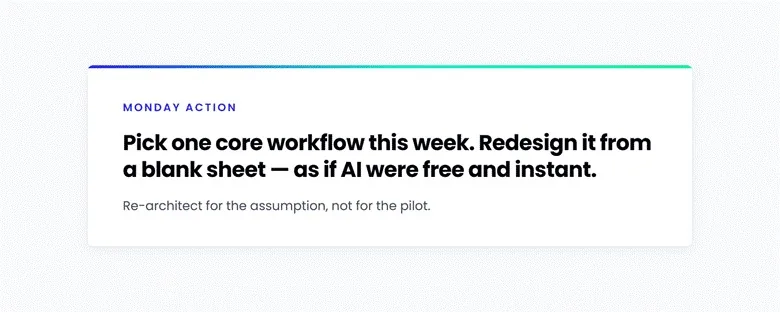
The practical starting point is not another portfolio of pilots. Choose one important workflow and redesign it from a blank sheet as though AI were free and instant. Then add the necessary human judgment, controls and governance.
The gap between that design and the way the work happens today is not merely an implementation gap. It is the strategy.
The question is no longer whether your organization has adopted AI. It is whether you have redrawn the building around it.
AI is not the hard part. Reinventing the enterprise is.
Giedre Malinauskaite
Chief Strategy Officer (CSO)
Related Resources
All ResourcesNews, Partner Community
Fueling Cloud Adoption: CNTXT Launch Google Cloud Reseller Ecosystem for Rapid Growth in the Kingdom
News
CNTXT Offers Sovereign Controls to Google Cloud Customers in Saudi Arabia

Get in touch
There are many ways of “doing cloud” but not all of them will future-proof your business. We can devise an approach that will. Talk to us today – you have nothing to lose but the guesswork.
Contact Us